Inverness Angling Club
 Home ] [ Club Details ] [ Permits ] [ Club News ] [ Where to Fish ] [ Flies & Lures ] [ Picture Gallery ] [ Local Links ] [ Travel Info
A good selection of hairwing flies

     [Pop up picture]     

A nice selection of shrimp flies

     [Pop up picture]     

Flies and Lures

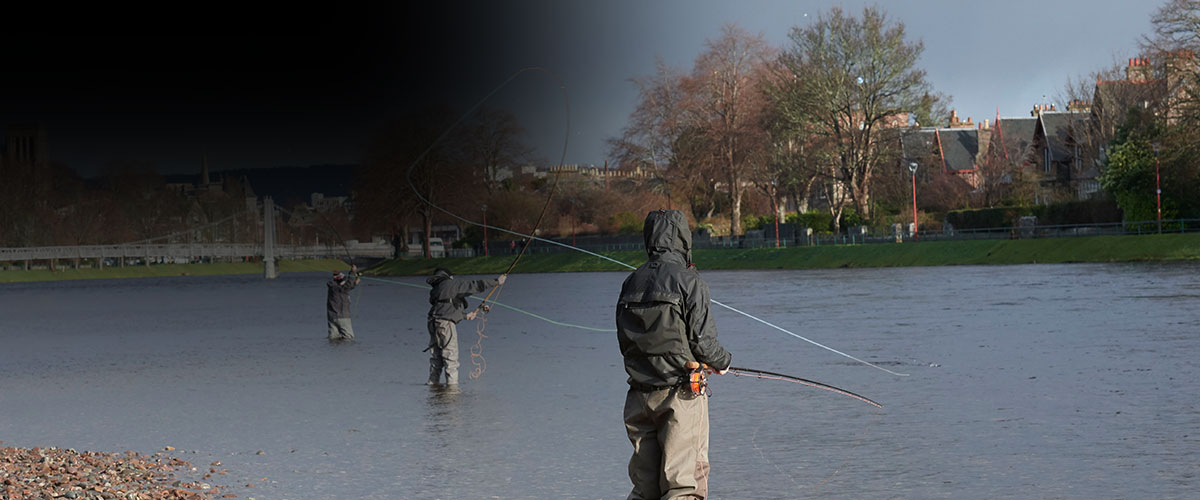
      Fly fishing is the most successful method for catching Ness salmon, fished on double-handed rods of 14 to 16 feet using lines rated at AFTM 9 to 11. The ability to Spey cast, for which Ness anglers are famed, is useful as many pools do not offer sufficient room for overhead casting.

      Small flies – 8s, 10s or 12s – are more productive than large flies, depending on water height. Popular patterns include shrimp flies in red, yellow, orange or black, Munro’s Killer, Stoat’s Tail and Silver Stoat, but traditional or modern flies with any or all of these colours will attract fish. Long tailed flies, with a lot of movement, and silver, gold or other metallic-style bodies, work well, particularly for grilse.

      Spinning and worming are allowed. Popular spinning lures include Devons and Tobies of various sizes depending on water height. Worm fishing is permitted between March 15 and September 30 but prohibited outwith these dates.


The birth of the Black Shrimp
By: John Cathcart - January 20th, 2007

     During the early 1960s, when fishing the Inverness Angling Club water, I met up with another keen angler, Steve Fraser Jnr. We often met at our favourite pool, the MacIntyre, on the Rossie Lodge side, and our friendship grew. We were both very interested in fly-tying and we began to experiment in making wooden devons.

         When we met up on the river with a whole day ahead of us, we would fish as a team. If Steve fly fished, I spun. If we both fly fished, he would fish his favourite fly, The Sweep, and I would fish my then favourite The Shrimp. [Pop up picture]

     The fish were plentiful in those days and one day, fishing as a team, we landed the grand total of 12 fish, six each weighing from eight to 18 lbs!

We bought a wood turning lathe and began to seriously produce wooden devons in fair quantities – and we had plans! But things seldom go to plan and, on 9th September 1965, poor Steve, in his prime at 27 years and with so much ahead of him, was tragically killed.

I was put off fishing for a while after that but, one night with nothing to do, I took out my fly-tying kit, put a number 6 double in the vice and wondered what fly I would tie. It was then I thought I would tie a fly in memory of Steve. Using the colour of the Sweep and the long tail of the Shrimp, the Black Shrimp was born.
[Pop up picture]

    I reckon that some of Steve’s magic was passed on to me through this fly for I have since caught many hundreds of salmon on it. My best was 13 in a day, on the Dochfour beat of the Ness, and my best tally on the club water was 51 in three weeks. Those were the days!!

Dressing for the Black Shrimp

Hook size 12 to 2 double or treble
Tag Five turns silver wire
Tail Long fibres of black cock hackle or, for larger sizes, black squirrel tail
Rear half body Yellow floss, ribbed silver oval tinsel
Middle hackle Orange cock
Front half body Black floss, ribbed silver oval tinsel
Cheeks Jungle cock (half length of hook), one each side at top
Hackle Long black cock hackle
Head Black varnish

Visit the Black Shrimp Fly tying tutorial page to see the step by step tying.

Black Shrimp’s book goes on sale 27th June 2007

A book by Inverness Angling Club honorary member, the late John Cathcart, written in the last months of his life, is now on sale from local tackle dealers John Graham and Company in Castle Street, Inverness.

     [Pop up picture]

Priced at £9.99, the book is available either at the shop or through Graham’s online shopping service – www.grahamsonline.co.uk - for which a post and packing charge will be applied. Buy online Here directly from Grahams tackle shop Inverness.

‘On the Beat with Black Shrimp’ records over half a century of Highland angling history and reflects John’s enduring passion for the sport and his unique understanding of the freshwater environment.

It was John’s hope that the book would stimulate the interest of the next generation and inspire them to develop the skills and enthusiasm for angling for which Inverness exponents of the noble art are renowned.

 Home ] [ Club Details ] [ Permits ] [ Club News ] [ Where to Fish ] [ Flies & Lures ] [ Picture Gallery ] [ Local Links ] [ Travel Info